The Video Compute Trap has an exit.
VPU-native infrastructure cuts streaming OPEX by 80–95%. Arcadian is how you get there.
Most streaming platforms run video infrastructure designed for a world that no longer exists — CPUs and GPUs never built for video at scale. The cost hides in your per-stream economics, rack density, and power bills.
You're not competing with other streaming platforms.
You're competing with the wrong silicon.
The most efficient video infrastructure in the world isn't for sale. Google built Argos — 20–33x more compute-efficient than CPUs. Meta built MSVP. Neither is commercially available. Akamai, the top Asian hyperscalers and many of the largest media and streaming companies took a different path: NETINT's commercial VPU — the same architecture Arcadian deploys.
NETINT calls this the Video Compute Trap: the moment scaling streams means scaling spend, and the math never quite works. Four levers create it — compute scaling, energy and density, egress pressure, and operational complexity.
GPUs dabble in video. CPUs choke on it. A VPU is the first silicon designed to do exactly one thing, at maximum efficiency, at maximum density.
The first silicon 100% dedicated to video.
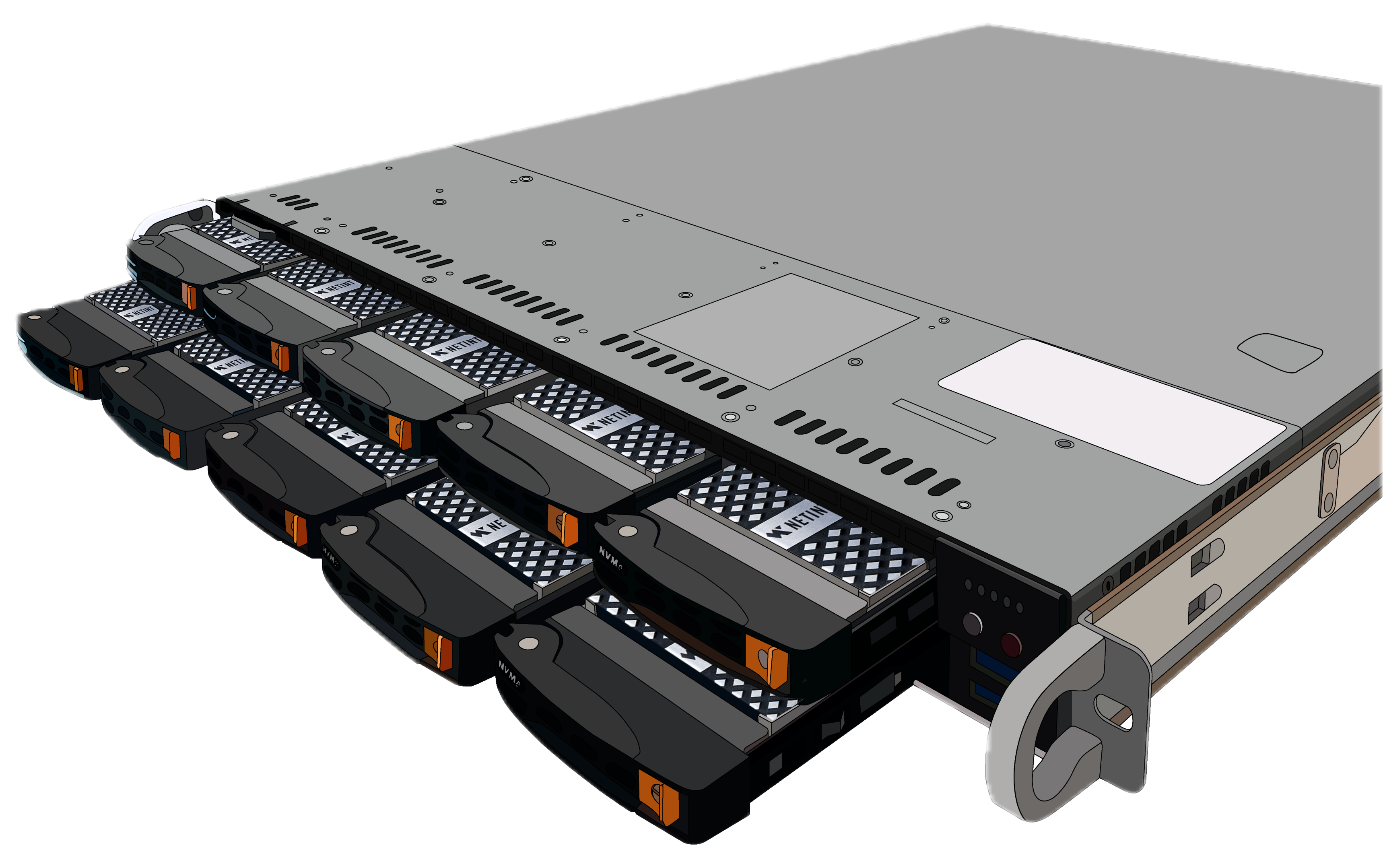
The Quadra T1U — Arcadian's primary enterprise deployment unit — encodes 32 simultaneous 1080p30 streams (or 8 at 4K, 2 at 8K) at 17W at rest, 27W under load. Run ten T1U cards in a single 1U server: 320 simultaneous 1080p30 streams per rack unit.
| NETINT Quadra T1U | Supported codecs & features |
|---|---|
| Encode | AVC/H.264 · HEVC/H.265 · AV1 Main · JPEG |
| Decode | AVC/H.264 · HEVC/H.265 · VP9 · JPEG |
| Features | HDR10/HDR10+/HLG · sub-frame latency · ROI · up to 8K · 15 TOPS on-chip AI |
4.2x to 5.8x energy efficiency advantage.
Tested independently. Not by us. Not by NETINT.
| Codec / Res | NETINT T1U | Advantage |
|---|---|---|
| H.264 1080p | 0.61 W | 4.2x |
| H.264 720p | 0.50 W | 5.2x |
| HEVC 1080p | 0.71 W | 4.9x |
| AV1 1080p | 0.68 W | 5.2x |
| AV1 720p | 0.43 W | 5.8x |
| Per stream | CPU | GPU | VPU |
|---|---|---|---|
| Cost / stream | $473 | $285 | $65 |
| CAPEX vs CPU | — | 25%↓ | 86%↓ |
| OPEX vs CPU | — | 55%↓ | 95%↓ |
Source: Cires21–NETINT Whitepaper (Sept 2025) · NETINT 320-stream cost analysis
Where you start depends on what you have. Where you end up is VPU-native.
Upgrade Current Hardware
Add NETINT T1U / T2A PCIe cards to existing servers. The fastest path to VPU economics — no new rack space.
Quadra Video Servers
Turnkey 1U appliance: ten T1U VPUs = 320 1080p30 streams per rack unit. 180 TOPS on-chip AI.
VPU IaaS on Akamai Cloud
Subscription VPU compute, no CAPEX. Akamai egress at $0.005/GB vs ~$0.09/GB industry standard.
Hybrid (On-Prem + Cloud Burst)
Baseline on-prem at lowest cost; burst to Akamai VPU cloud at peak. Arcadian manages routing & failover.
We don't install hardware. We integrate infrastructure.
Consultation & Architecture
We start with your workflow, not a hardware catalog. Deliverable: design + deployment plan.
Custom Software Integration
Encode pipeline, API, monitoring, custom tooling — built to your spec, not a template.
Testing & Optimization
Tuned against real streams and load until it meets Phase-1 targets. Go-live sign-off.
Ongoing Support
SLA-based support as content, scale, codecs and firmware evolve.
These aren't projections.
They're outcomes from production deployments.
Documented annual OPEX reduction after CPU → GPU → ASIC VPU migration. Sub-2s latency, 24/7/365.
Quadra T1U at 50% utilization. Cost so low they made transcoding free for all customers.
Ten CPU servers replaced by one Quadra Video Server. Same output, one-tenth the footprint.
AV1 at scale is a silicon problem.
VPUs are the silicon that solves it.
The T1U encodes AV1 at 0.43–0.68 W/stream across the full resolution ladder. 51.5% of organizations now evaluate VPUs — approaching parity with GPU intent (53.6%) for the first time.
The economics are decided by the architecture you choose today.
For one high-volume streaming platform, running equivalent workloads on AWS over five years cost 15x more than their on-prem VPU infrastructure. Every quarter delayed, that gap compounds. Arcadian's engagement starts with a VPU Architecture Review.
Source: NETINT, "Understanding the Economics of Transcoding," Jan Ozer, NETINT.com